
Text written for the catalogue published on the occasion of the exhibition “Schlafende Geschichten” (Latent Stories) at the Langmatt Museum (Baden, Switzerland) from September 20, 2026, to January 10, 2027.
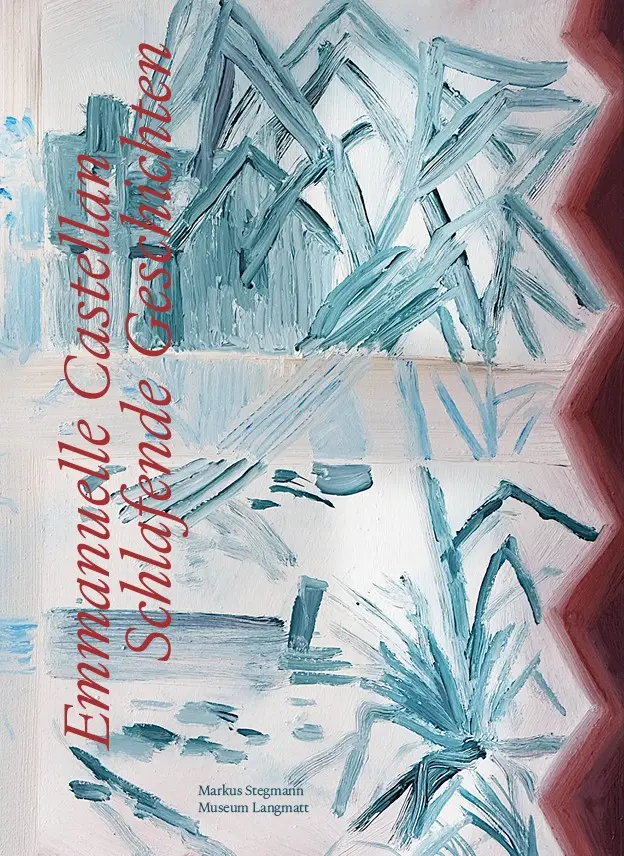
Emmanuelle Castellan – free associations
Emmanuelle Castellan says without hesitation, “The painting uses me as a vehicle, and what is accomplished no longer belongs completely to me.”She adds, “A canvas is finished when I have managed to detach myself from it. My real life plays out in my paintings; a painting is finished when I have understood a problem, what is worrying me in an image, why it speaks to me so…”
Emmanuelle Castellan studied in France in the 1990s. At that time, painting was often considered a bourgeois, egocentric and apolitical medium that had lost its legitimacy. But the young artist was drawn to painting in an almost physical way. Since her time studying at art school, she has found a kind of refuge in this medium, where it is possible to be absolutely convinced that objects are not necessarily visible – and that our relationship with words, objects and images is always shaped by an element of projection, ghosts and fantasies.
When she explored the possibilities of installation art and developed patchwork painting, Emmanuelle Castellan immersed herself in Nicolas Bourriaud’s Relational Aesthetics, a book which marked a milestone in France and beyond in the early 2000s. If reading this book reinvigorating debate on the dialogical nature of art[1] fuelled her, it was in the solitude of painting that she found solace – a solitude focussed on an internal dialogue, one that never abates and which remains uncomfortable, allowing her to establish a non-negotiable position. “To find one’s niche without having to articulate or justify it. Painting is an easy activity that doesn’t take a toll,” she says.
The home as a studio
This strength and freedom are based on an economy of art. For years now, Emmanuelle Castellan has had a home studio in the Moabit quarter of Berlin. You have to cross the living room to reach her workplace – the two spaces are separated by a double door that I have never seen closed. Here, work and life merge into one. This is also reflected by the recurring themes of utilitarian objects as vessels for artistic expression that permeate the sketches, drawings, gouaches, collages and canvases – glasses, bowls, vases, mirrors, coat hangers, fans and hats come and go. They contain, support, nurture and protect. Emmanuelle Castellan recalls at every opportunity that she shares the fundamental principles of movements and associations such as Arts and Crafts, Wiener Werkstätte, the Nabis and, closer to our own time, the radicalism of the defamiliarisation of everyday, mundane activities started by Marguerite Duras and Chantal Akerman – I would also like to add Colette here.[2]
Whether they can be identified by the title, or are shown as elusive outlines, female figures feature prominently in Emmanuelle Castellan’s work, which welcomes them into her “home”. This hospitality, always bordering on the fantastical, is consciously explored by the artist – for example, in a series of paintings dedicated specifically to Nathalie Granger (1972). Duras filmed Lucia Bosè, Jeanne Moreau and Gérard Depardieu (a little) in her house at Neuphle-le-Château, a place of creation, sharing and filming. Duras’ films were also based on the strict principle of a subtle, malleable, domestic economy, the sole guarantor of a radical, non-negotiable freedom to explore. Furthermore, like Duras, Emmanuelle Castellan sometimes depicts men, often with irony[3] – such as Michael Lonsdale, the spurned lover in India Song (1975), portrayed as a prisoner in a Wiener Werkstätte vase.
This preoccupation with economy – implying recycling and circularity, and which can be found equally in Duras and Brancusi, who also lived in his studio, surrounded by works oscillating between sculpture, pedestal and stool – manifests itself in Emmanuelle Castellan’s work through very concrete gestures. She makes her own paints which, mixed with chalk, produce matte, powdery materials with an earthy materiality; she reuses her canvases, which appear like a family with defined contours, whose combinations and recombinations carry with them future, never-ending scenes. Emmanuelle Castellan’s “domestic painting” presents a crystal-clear initial setting. There is no artificiality here, nothing luxurious or sophisticated.
Chronicle of feelings
Whether it is in her relationship with childhood – that “internal, wild journey” as Duras called it – or with the tradition of painting, or ultimately with her Berlin surroundings,[4] a faint nostalgia seems to hover. This is a way of positioning herself, which is both precise and atmospheric, with the method of Alexander Kluge who, like Duras, also worked at the boundary between literature and cinema. In his epic Chronicle of Feelings, Kluge uses 500 short stories to sketch a sentimental landscape of the 20th century, from a German perspective. As in a series of pictures, Kluge fictionalises using facts and documents. Photographs, postcards, cuttings from magazines and so on are condensed by his subjectivity.
Emmanuelle Castellan’s quest, which can already be seen clearly in the sketches, preliminary studies, collages and gouaches that form a tapestry of mental and physical images, shares this same concern to capture subjective time. The artist constantly questions cartoons, caricatures, satire, advertising, film sequences and the social nature of images in order to better capture the particular temporality of the picture, a hybridization of history and stories. The format choice is not anodyne and Emmanuelle Castellan has used the 16:9 aspect ratio in her installations, underlining even further the importance of cinema and television as a cultural industries.
Apart from the potent, thoughtful interest in the feminine, her series of screen paintings are obsessed with Germanic fantasy. Here it is possible to identify motifs, archetypes, idols, dreams and memories simultaneously evoking romantic scenery, New Objectivity, expressionist cinema, Berlin cabarets, the Baader-Meinhof Group or the films of Fassbinder and Syberberg. These references are also a subtle but firm positioning with regard to the schools on both sides of the Rhine: neither on the side of the paragons of Realism – whether “socialist” or “capitalist” – and their heirs, nor on that of Neue Wilde neo-expressionism or other shrines to figurativism. Instead, her family sits alongside Norbert Schwontkowski, Luc Tuymans, Raoul De Keyser, Jutta Koether and Sanya Kantarovsky, who have all explored the hesitant, open but nevertheless effective dimension of a painting, drawing equally on caricature and abstraction, documentary image and archetype.
The politics of enigma
Examining the part that chaos plays in a picture allows Emmanuelle Castellan to avoid a circumscribed, secure definition of painting made up of rules and technical or narrative know-how. “I don’t want to be in an authoritarian position; this can be found in my paintings and the way I compose them,” she explains. Constructing and deconstructing a pictorial space never produces a fixed meaning; for her and us it is more a question of enigmas that absorb their environment. The radicalism of cuts and frames, the shock of overlays, folds and the resulting associations can seem strange, contradictory or digressive. They do, however, trigger an interpretation – free and fleeting because a painting’s future remains open. The Plakate series reinforces this process, given the unfinished and fragmented nature of the composition.
Emmanuelle Castellan’s paintings, often without a structure, never framed, play with conventions without using words. Their almost psychological mechanism, approaching dream and free association as an analytical method, also leans towards caricature – a historically political activity characterised by an impact that is realistic, sometimes even explosive. “This is the kind of impact that I seek, but never attain,” she says. If she does try to get closer to it, it is always done in a lighthearted way. The relationship with reality passes through a fantastical prism, almost like a puzzle – that does not take account of an immediate reality that is always broadcast.
Emmanuelle does not hesitate to express the belief that any relationship with the meaning cannot be literal but is political. It is not unusual, moreover, for painted words, barely completed, to nestle within the composition. In this way the artist deconstructs language and begins another relationship with the image. It is a complete vision of the world that plays out here, picking up on the mechanisms of projection and ambivalence, mistrustful of ideologies and their interventionist attitudes to artists and which suggests – to borrow Jacques Rancière’s expression – “distribution of the sensible[5]” expressed by the painting itself.
[1] How art is produced and received. Even though Bourriaud’s book explicitly mentions the writings of Althusser, Deleuze and Guattari, it owes much to the concept of “dialogics” developed by Mikhail Bakhtin, a Russian literary theoretician and linguist, which was disseminated in France from the 1960s onwards, notably through the work of Julia Kristeva.Alongside “dialogics”, another of Bakhtin’s pioneering concepts, namely “free indirect discourse”, inspired numerous post-structuralist reflections that were decisive for French thought and which paved the way for issues that artists deemed essential just before the turn of the millennium: the intrinsically social, dynamic and mutable nature of the sign.
[2] Julia Kristeva, The Female Genius. Volume III, Colette, Paris, Fayard, 2022. At the end of this final volume in the series of essays devoted to the female, Kristeva writes: “Arendt, Klein, Colette – and so many others – did not wait for the ‘female condition’ to mature to achieve their freedom. Isn’t ‘genius’ precisely this breakthrough through and beyond ‘circumstances’?“
[3] Marguerite Duras, Yann Andréa Steiner, Paris, P.O.L, 1992, p. 21: “One day, at my place, Roland Barthes politely advised me to “return” to the kind of early novels that were “so simple and so charming”. I laughed.“
[4] From an ecological, even “ecosophical” viewpoint in the style of Félix Guattari, it can be said that Emmanuelle Castellan’s living environment influences her actions, thoughts, desires and fantasies.
[5] Jacques Rancière, Malaise dans l’esthétique (Aesthetics and its Discontents), Paris, Galilée, 2004, p. 38: “This distribution and redistribution of places and identities, this division and zoning of spaces and times, of the visible and invisible, of noise and speech constitute what I call ‘distribution of the sensible’. “